Blog
Thoughts on intelligence, consumer technology, and what comes next
Essays, launches, and research updates from the team at Rush.
An Agent You Can't Find Is an Agent You Don't Have
Run more than a handful of agents and the expensive engineering stops being intelligence. It becomes addressing — identity, index, and resume. The model is rented. The addressing is built.
Read essay →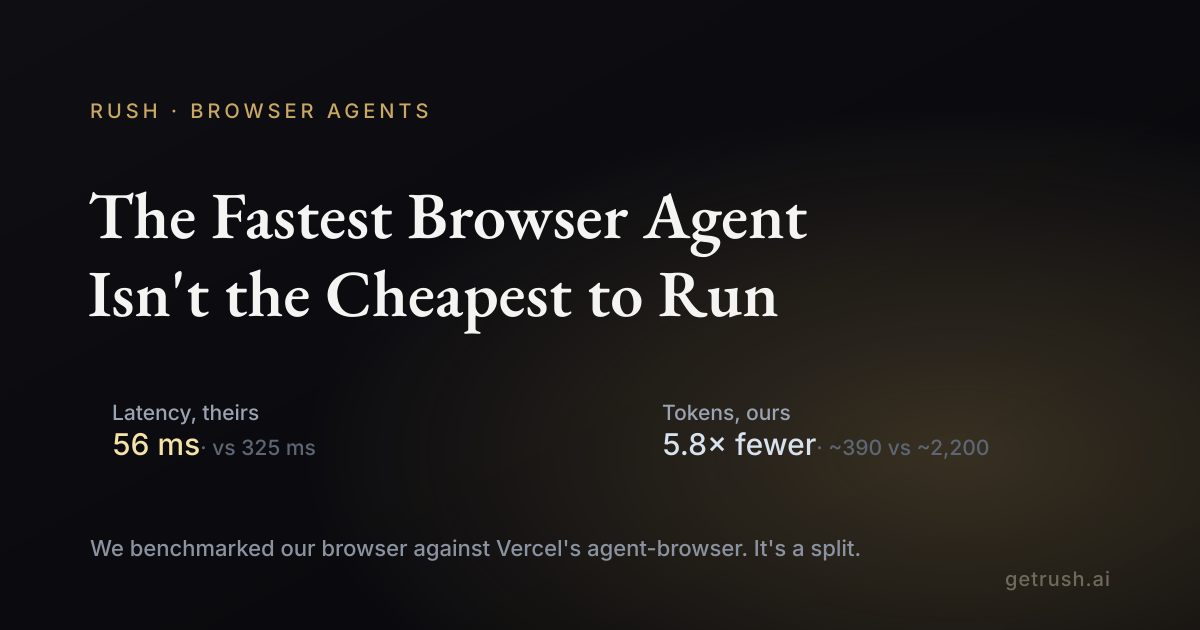
The Fastest Browser Agent Isn't the Cheapest to Run
Vercel's agent-browser is genuinely fast — native Rust, a warm snapshot back in 56ms. We benchmarked it head-to-head against the browser Rush agents drive, on a byte-identical page. It won on latency. We won on tokens, by 5.8×. Here's why tokens are the number that compounds.
Read →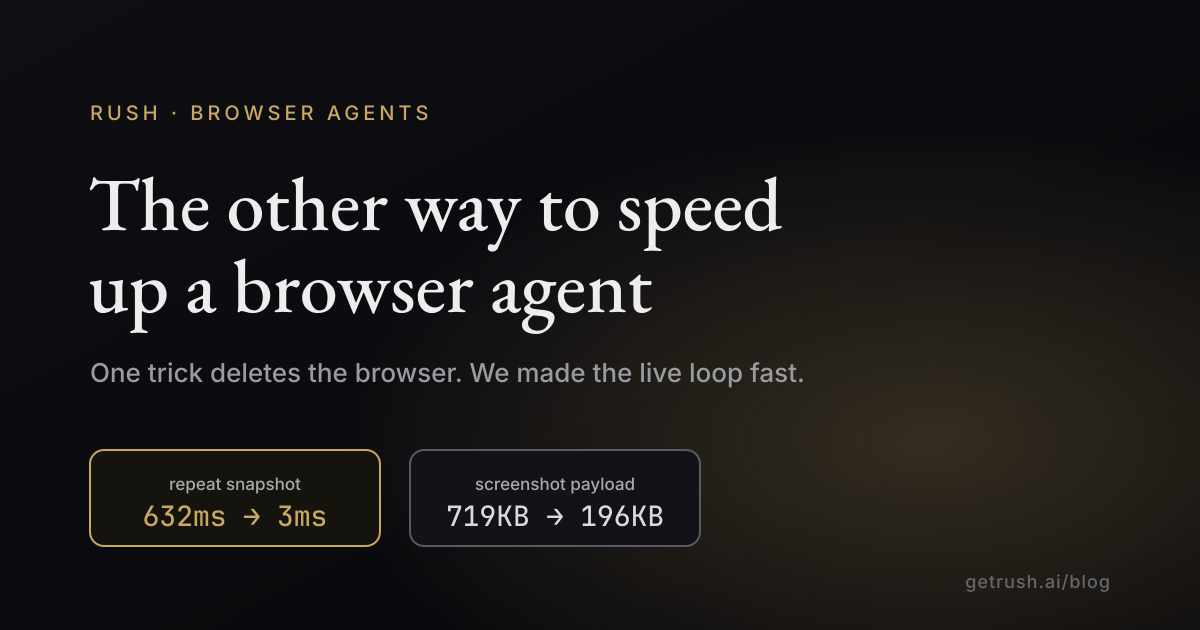
The Other Way to Speed Up a Browser Agent
A HAR trick making the rounds derives a typed client and deletes the browser — 30 seconds to 200ms. It's real, and it quietly assumes a stable API. Here's the other half of the problem: making the live browser loop itself fast. We took a repeat snapshot from 632ms to 3ms.
Read →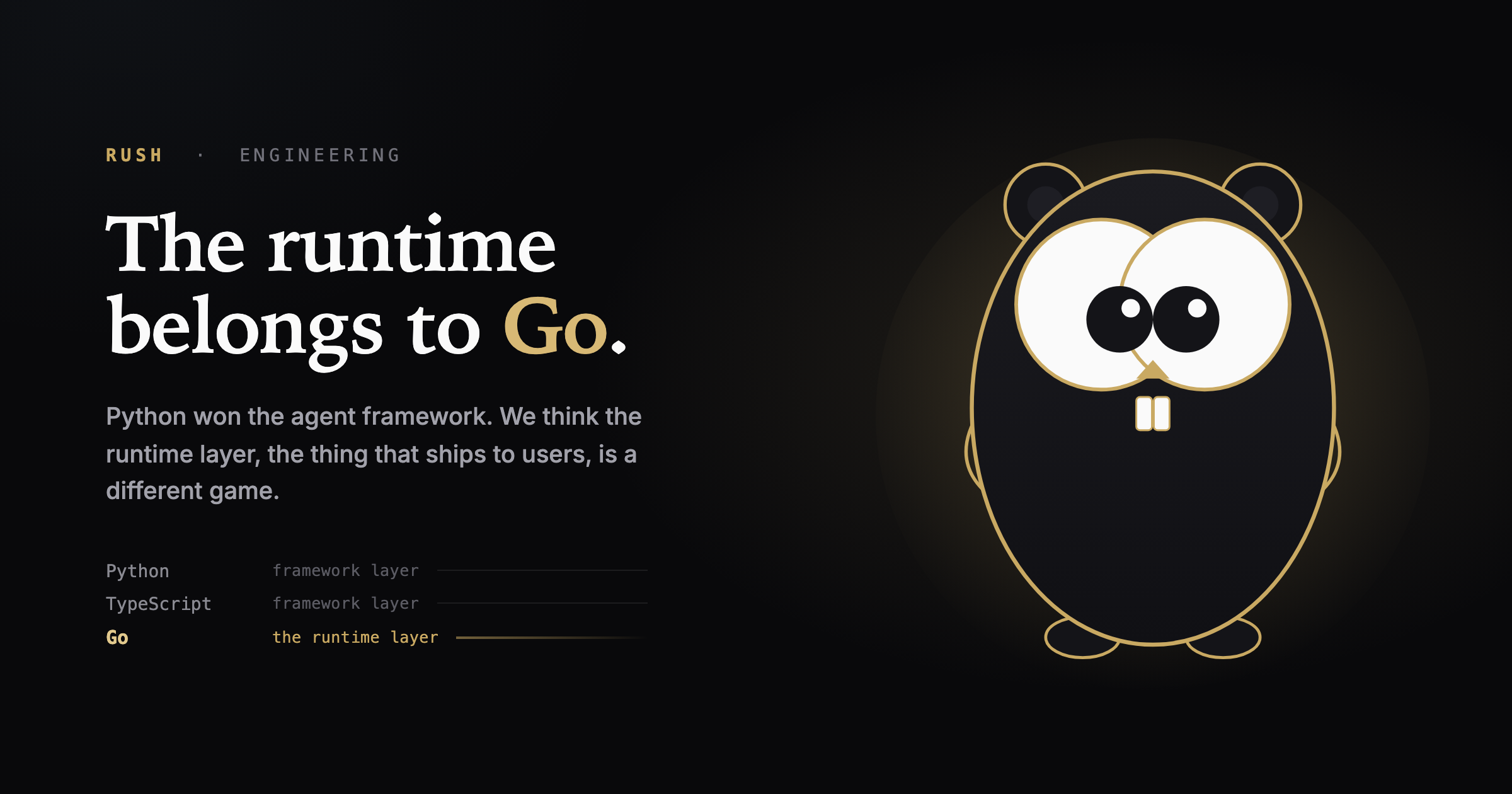
Why We Built Our Agent Harness in Go
Every agent framework is Python. We think that's a category error. The honest engineering case for a Go agent runtime, with the real code and the tradeoffs we won't pretend away.
Read →
After the Org Chart
The model is the steel; your memory is the core. In the agent era everyone rents the same mind, so you cannot out-model your rivals, only out-remember them.
Read →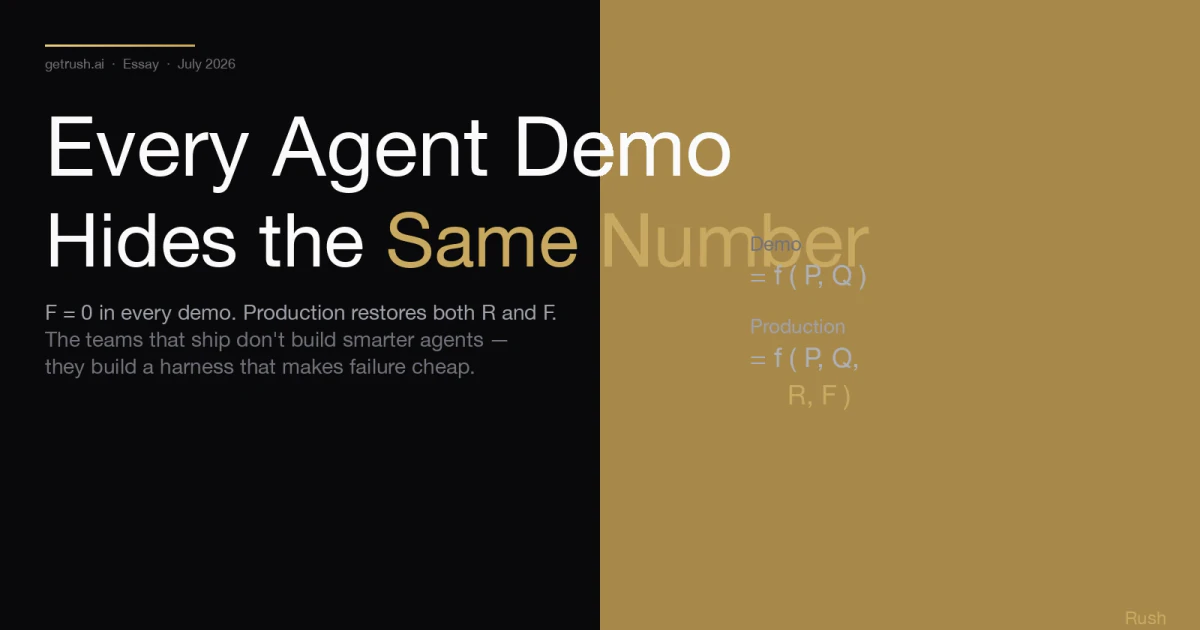
Every Agent Demo Hides the Same Number
A demo sets the cost of failure to zero and skips independent review. Production restores both. That delta — not the model — is what kills 88% of agent pilots.
Read →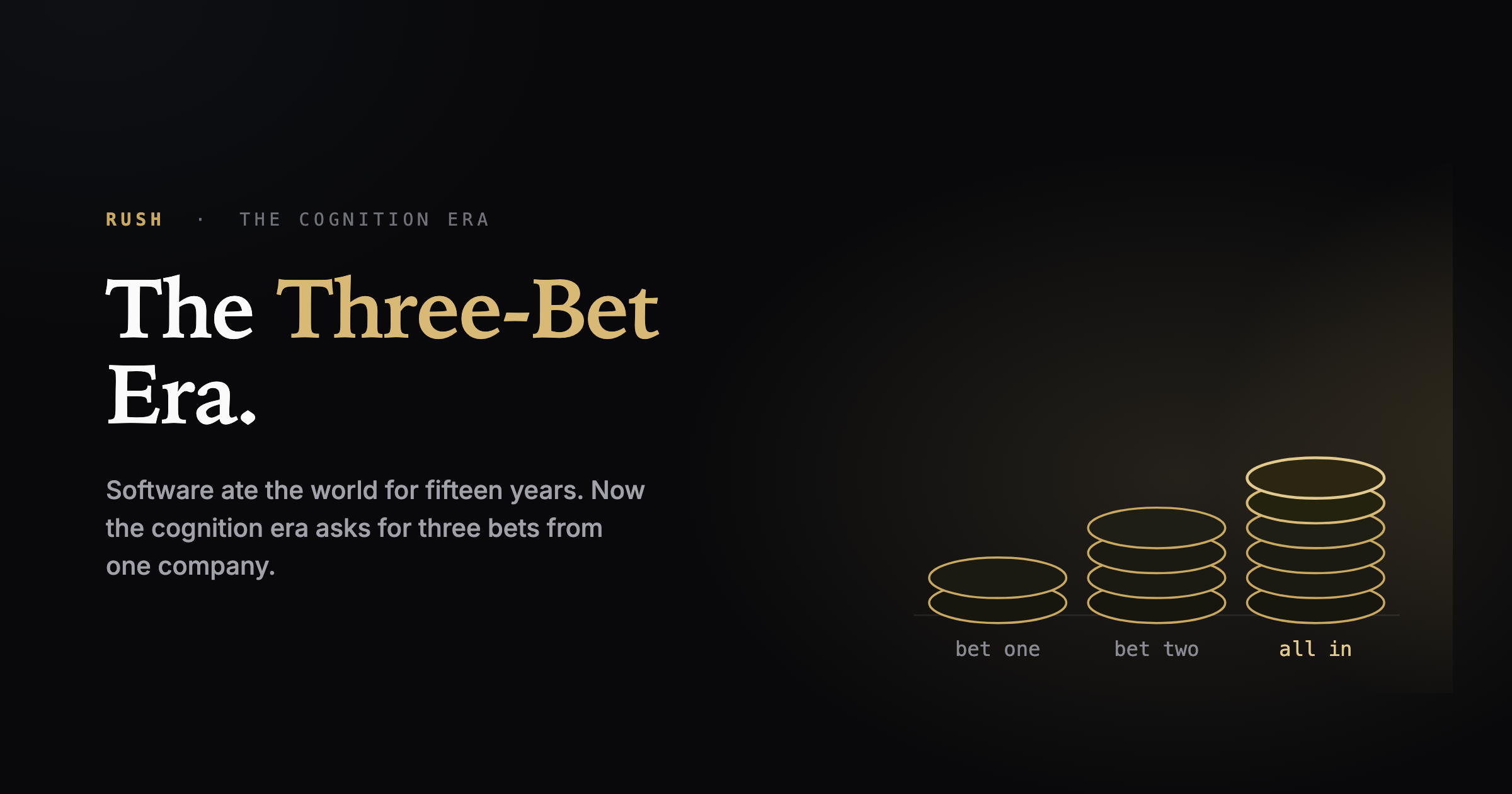
The Three-Bet Era
Marc Andreessen said software is eating the world. He was right for fifteen years. He's wrong now. The cognition era requires three bets from one company, and the wrapper class is about to find out the hard way.
Read →
Your Agent Doesn't Know Your Name
AI agents can reason across thousands of documents but cannot recall what you told them last Tuesday. The gap between tool and teammate is not intelligence. It is memory.
Read →
Agents Are Eating the Org Chart
AI didn't just automate coding. It made organizational judgment loops executable. Software factories are the prototype for a broader class of programmable institutions.
Read →
AGI Won't Pass a Test. It'll Build a Company.
The real test of general intelligence is whether AI can build a living, adaptive company from scratch. ARC-AGI 3 just showed how far that is, and why the distance matters.
Read →
Ephemeral Apps: Software That Exists for Five Minutes
Why the future of software isn't permanent installations but interfaces that spawn when you need them and dissolve when you don't
Read →
The Siri Trap: Why Single-Agent Assistants Always Fail
Siri launched in 2011. $100B+ invested across Siri, Alexa, and Google Assistant. After 15 years, the most common use case is still 'set a timer.' The failure isn't talent. It's architecture.
Read →
Agents for the Rest of Us
Developers got Codex. Enterprises got Frontier. The other 1.5 billion knowledge workers got 'in development.'
Read →
The Last App You'll Ever Install
Thousands of apps collapse into a handful of agents. You stop being the integration layer and start being the director.
Read →
2026: The Year Multi-Agent Systems Go Mainstream
From Moltbook's AI social network to enterprise swarms - why multi-agent orchestration is the new infrastructure moat.
Read →
The Missing Piece of the Intelligence Revolution
The cost of intelligence collapsed 280x in 18 months. Yet most people are still chatting. The models aren't the bottleneck.
Read →