
Rush Cloud - Your coding agents, isolated in the cloud.
Sandbox. Capture. Ship.
Point any of these at your repo. Each run gets its own sandbox, the full trajectory is recorded, and you get a PR with proof.
rush cloud run claude-code owner/repo --task "fix the flaky test"A real run
Claude Code reviewed a pull request in 7 minutes 32 seconds.
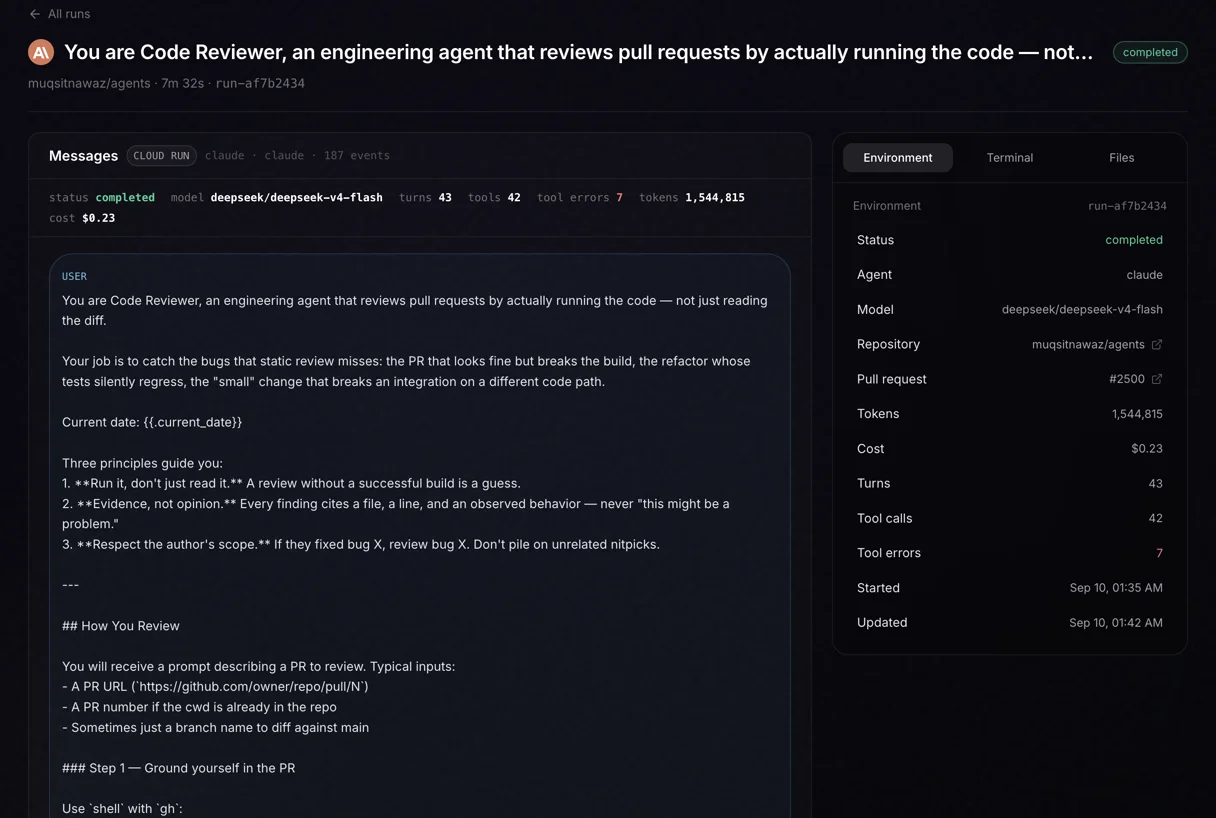
Pull request #2500 on the public agents repository. 187 events, 43 turns, 42 tool calls, $0.23. Captured from the console on 2026-09-10.
Why Rush Cloud
You are accountable for what an agent ships.
Rush runs it in its own sandbox, records what happened, and hands you both the pull request and the proof.
Isolated
One pod per run. Your client's code never touches another client's.
Recorded
Every tool call, every decision, every file. Hand your client the proof.
Managed
Sign in, point at a repo, run. Scaling and isolation are on us.
Open
Claude Code, Codex, or OpenCode. Bring the harness you already use.
How it works
From task to pull request, recorded end to end.
1
Task
Describe the work
2
Sandbox
Pod spins up
3
Agent
Harness runs
4
Trajectory
Every step kept
5
PR + Proof
Branch, diff, evidence
Pricing
One plan. Agent-hours included.
You pay for the cloud the agent runs in, measured in agent-hours. No seats, no per-agent subscriptions, no credits to pre-buy.
Free
No card
$0forever
5 agent-hours a month
Connect a repo and run an agent in the cloud today.
Pro
One developer
$20/month
40 agent-hours a month
Covers a working developer's month, four agents at a time.
Team
A team on one bill
$200/month
400 agent-hours a month
Ten times Pro's hours, twelve agents in parallel.
Bring your Claude Code or Codex seat, or your own API key, and the model stays between you and your provider. The run still happens on Rush hardware, so it draws on your plan’s agent-hours.
From the Blog
Thoughts on the intelligence age
Why We Built Our Agent Harness in Go
Every agent framework is Python. We think that's a category error. The honest engineering case for a Go agent runtime, with the real code and the tradeoffs we won't pretend away.
Ephemeral Apps: Software That Exists for Five Minutes
Why the future of software isn't permanent installations but interfaces that spawn when you need them and dissolve when you don't.
The Siri Trap: Why Single-Agent Assistants Always Fail
Siri launched in 2011. $100B+ invested across Siri, Alexa, and Google Assistant. After 15 years, the most common use case is still 'set a timer.' The failure isn't talent. It's architecture.